
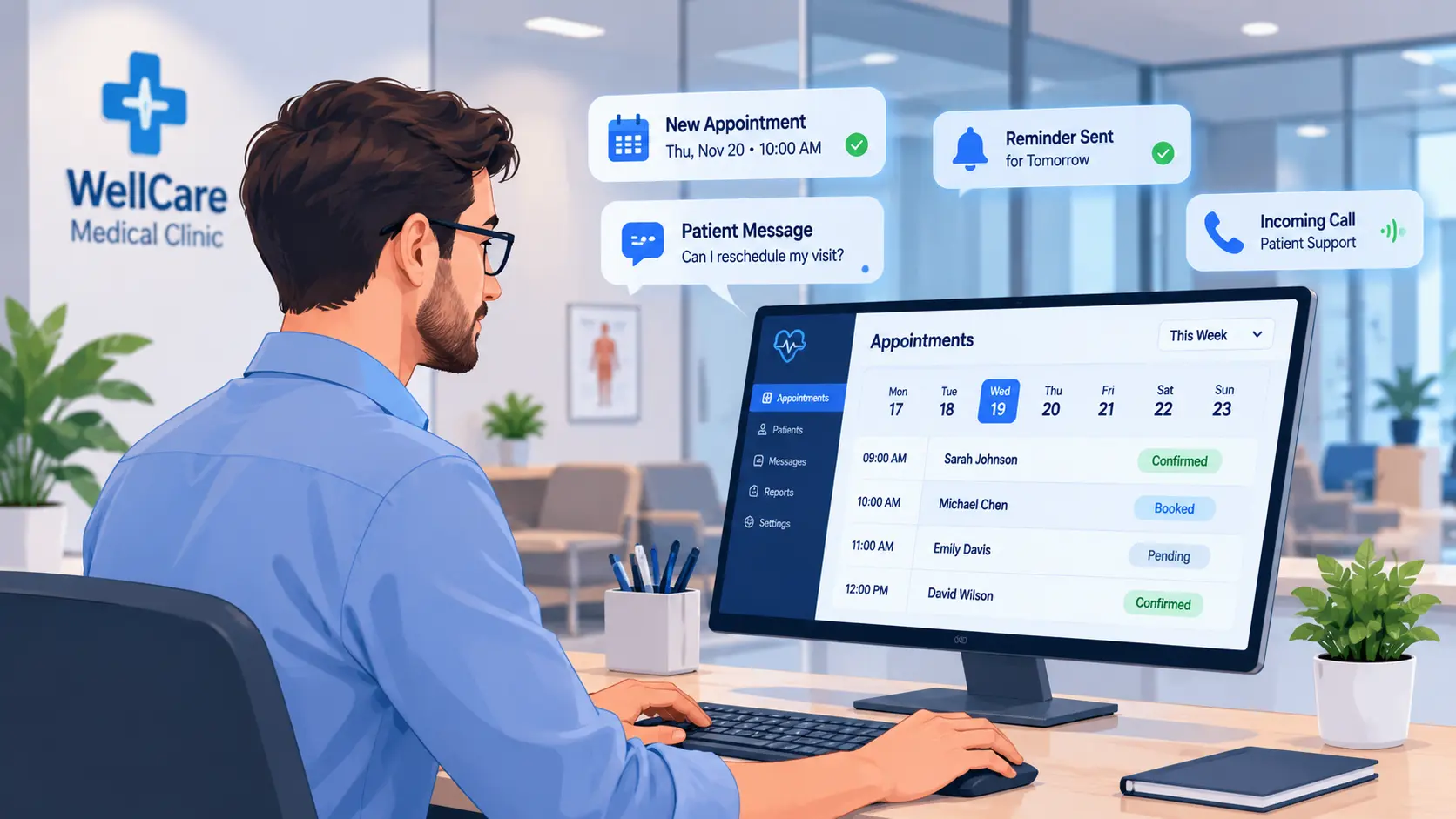
Imagine a patient visits your clinic’s website at 11:30 PM. They want to book an appointment, ask about consultation fees, or find out whether the clinic accepts their insurance. Unfortunately, the clinic is closed, and nobody is available to answer their questions.
The patient may leave the website and book an appointment with another clinic that responds faster.
Now imagine a different situation. The patient receives an immediate response from an AI Appointment & Front Desk Agent. It answers their questions, checks available appointment slots, helps them book a suitable time, and sends a confirmation message automatically.
The entire process happens within minutes, without requiring a receptionist to be available.
This is the idea behind an AI Appointment & Front Desk Agent: an intelligent virtual assistant that helps clinics manage appointments, communicate with patients, and handle repetitive front-desk tasks around the clock.
For medical clinics, dental practices, diagnostic centers, and specialist healthcare facilities, this technology can improve patient experience, reduce administrative workloads, and help staff focus on more important responsibilities.
Let’s explore how it works, what features it offers, and how it can save clinics time and money.
What Is an AI Appointment & Front Desk Agent?
An AI Appointment & Front Desk Agent is a software-based assistant designed to automate routine administrative and patient communication tasks.
Unlike a traditional chatbot that only provides predefined answers, an advanced AI agent can understand natural language, maintain conversational context, retrieve information from connected systems, and perform authorized actions such as scheduling an appointment or updating a booking.
For example, a patient might type:
“I need to see a dentist next Tuesday afternoon. Do you have any available appointments?”
The AI agent can understand the request, check the clinic’s scheduling system, identify suitable openings, and present available options. Once the patient selects a time and provides the necessary information, the agent can create the appointment and send a confirmation.
Depending on its configuration and integrations, it can operate through:
- The clinic’s website.
- WhatsApp messaging.
- Live chat.
- SMS and email.
- AI-powered voice calls.
- Telephone systems with conversational voice AI.
The goal is not necessarily to replace human receptionists. Instead, it is to automate repetitive tasks, make patient communication available beyond office hours, and allow human staff to concentrate on work that requires personal attention.
Essential Features of an AI Appointment & Front Desk Agent
Feature 1: 24/7 Patient Communication
Traditional front desks operate according to clinic opening hours. However, patients do not always search for healthcare services during those hours.
Someone might look for a dermatologist late at night, while another patient may want to confirm an appointment early in the morning.
An AI agent can respond at any time, providing information about clinic services, opening hours, locations, appointment procedures, and other frequently asked questions.
It can also collect appointment requests outside business hours and, where scheduling permissions allow, book available slots immediately.
The benefit: Patients receive faster assistance, and the clinic has more opportunities to convert website visitors into booked appointments.
Feature 2: Automated Appointment Booking
Appointment scheduling is one of the most valuable functions of this AI agent.
Patients can describe their needs in ordinary language instead of navigating complicated booking forms.
For example, a patient may request a consultation with a cardiologist on Friday morning. The AI agent can check the relevant provider’s schedule and offer available times.
After confirming the patient’s selection, it can create the booking in the clinic’s appointment management system.
A well-integrated agent can also account for factors such as:
- Doctor availability.
- Appointment duration.
- Clinic location.
- New or returning patient status.
- Service type.
- Scheduling rules and buffer times.
The agent should only confirm an appointment after the connected scheduling system has successfully recorded it.
The benefit: Less time spent on telephone calls, fewer manual scheduling tasks, and a smoother booking experience for patients.
Feature 3: Appointment Rescheduling and Cancellation
Patients frequently need to change their appointments because of work commitments, travel, family responsibilities, or unexpected circumstances.
Handling these requests manually can occupy a significant portion of a receptionist’s day.
An AI agent can identify the existing appointment, verify the patient’s identity using an appropriate process, check the clinic’s cancellation and rescheduling rules, and offer alternative times.
If a patient cancels, the system can update the appointment record and potentially make the slot available to another patient.
This process can reduce the number of calls staff must handle and make it easier for patients to manage their appointments.
Feature 4: Automated Appointment Reminders
Missed appointments can create financial losses, disrupt clinical schedules, and prevent other patients from receiving timely care.
An AI agent can help reduce these problems by sending reminders before scheduled visits.
For example, a clinic might configure reminders to be sent 48 hours and 24 hours before an appointment, depending on its policies and patient communication preferences.
A reminder could say:
“Your appointment is scheduled for tomorrow at 10:30 AM. Please confirm your attendance or let us know if you need to reschedule.”
Patients can respond directly, and the system can record their confirmation or initiate a rescheduling process.
Reminders can be delivered through SMS, WhatsApp, email, or automated voice calls, depending on the clinic’s systems and the patient’s consent.
The benefit: Better appointment attendance, fewer empty time slots, and less manual follow-up work.
The actual reduction in missed appointments depends on the clinic’s patient population, reminder timing, and existing processes.
Feature 5: Answering Frequently Asked Questions
Receptionists repeatedly answer questions about consultation fees, clinic timings, parking, insurance, available services, and appointment preparation.
Although these questions are important, answering them individually consumes time that could be used for more complex patient needs.
An AI agent can respond to common questions using information approved by the clinic.
For example:
- What time does the clinic open?
- Do you offer dental cleaning?
- Which insurance plans do you accept?
- Where is your clinic located?
- What documents should I bring to my first appointment?
- How can I reschedule my consultation?
The clinic can maintain an approved knowledge base containing accurate information about its services, policies, and procedures.
If a question falls outside the agent’s knowledge or requires professional judgment, it should transfer the conversation to an appropriate staff member rather than invent an answer.
Feature 6: Patient Registration and Information Collection
Patient registration often involves collecting names, contact details, appointment preferences, and other relevant information.
An AI agent can guide patients through this process before their visit.
For example, it may collect basic contact information, identify whether the patient is new or returning, and direct the patient to secure intake forms when additional information is needed.
Information can then be transferred to the clinic’s practice management system or electronic health record, provided the integration is authorized and properly configured.
This reduces duplicate data entry and helps staff prepare for upcoming appointments.
However, sensitive medical information should only be collected when necessary and handled through secure, appropriately protected systems.
Feature 7: AI-Powered Voice Receptionist
Not every patient prefers messaging or website chat. Many people still prefer calling a clinic.
An AI voice agent can answer incoming calls, understand spoken requests, provide approved information, and assist with appointment scheduling.
For instance, a caller might say:
“I need to book a follow-up appointment with my doctor.”
The voice agent can ask relevant questions, check availability, and guide the caller through the booking process.
If the caller has a complex request, is distressed, or explicitly asks to speak with a person, the system should provide an appropriate transfer or callback option.
Voice AI can be particularly useful for clinics that receive many routine calls throughout the day.
Feature 8: Multilingual Patient Support
Clinics often serve patients who speak different languages or are more comfortable communicating in a language other than English.
An AI agent can support multiple languages, depending on the capabilities of the selected model and the clinic’s configuration.
It can help patients understand booking procedures, clinic policies, and appointment instructions in their preferred supported language.
For healthcare organizations serving diverse communities, this can make routine communication more accessible.
Medical terminology and translated instructions should be reviewed carefully, particularly when misunderstanding could affect patient safety.
Feature 9: Human Handoff and Staff Notifications
Automation should not mean that patients lose access to human assistance.
Some requests require empathy, clinical judgment, or administrative authority that an AI agent should not exercise independently.
A well-designed system can recognize when a conversation needs human involvement and route it to the appropriate person.
Examples include complex billing disputes, complaints, unusual scheduling requests, and questions about symptoms or treatment.
The agent can provide the staff member with a concise summary of the conversation, reducing the need for the patient to repeat everything.
Emergency-related messages should follow clinic-approved escalation procedures, including clear instructions to contact local emergency services when appropriate.
How Does the AI Appointment Agent Work?
The system typically combines several technologies and integrations.
Step 1: Patient initiates a conversation.
The patient contacts the clinic through a website, messaging platform, or telephone number.
Step 2: AI understands the request.
Natural language processing and a language model help interpret the patient’s message, identify the purpose of the conversation, and determine the next appropriate action.
Step 3: The agent retrieves relevant information.
It accesses approved clinic information, appointment availability, service details, or scheduling policies through connected systems.
Step 4: The agent performs the authorized task.
Depending on its permissions, it can book an appointment, update a booking, send a reminder, collect basic information, or escalate a request.
Step 5: The patient receives confirmation.
The agent communicates the result and provides the next steps.
Step 6: The clinic receives updated records.
The system records the interaction and updates relevant systems where supported.
The technology stack may include an AI language model, a conversation management layer, a scheduling integration, messaging or voice services, a secure database, and reporting tools.
The quality of the solution depends not only on the AI model but also on reliable integrations, clear operating rules, privacy safeguards, and appropriate human oversight.
Major Benefits for Medical and Dental Clinics
Reduced Administrative Workload
Receptionists often spend a large part of their day answering routine questions, confirming appointments, and handling scheduling changes.
Automating suitable tasks allows staff to dedicate more time to patients who need personal assistance.
Better Patient Experience
Patients increasingly expect convenient digital services and quick responses.
An AI agent reduces waiting for routine answers and allows patients to request appointments without being restricted to traditional telephone hours.
Fewer Missed Appointment Opportunities
When patients can book appointments after hours, clinics can capture requests that might otherwise go unanswered.
Automated reminders and easier rescheduling can also help reduce avoidable gaps in the schedule.
More Efficient Staff Utilization
Instead of hiring additional administrative staff solely to manage predictable increases in routine inquiries, a clinic may be able to handle more interactions with its existing team.
The actual staffing benefit depends on inquiry volume, workflow complexity, and how much work the agent can reliably automate.
Improved Consistency
An AI agent can use an approved knowledge base to provide consistent answers about opening hours, booking policies, and service availability.
This reduces variation caused by busy periods or differences in how staff communicate information.
Greater Operational Visibility
Reporting tools can help clinic managers understand call volumes, common patient questions, booking conversion rates, rescheduling patterns, and unresolved requests.
These insights can inform staffing decisions and operational improvements.
How Much Time and Money Can a Clinic Save?
The financial value of an AI Appointment & Front Desk Agent depends on the clinic’s size, appointment volume, staffing costs, and the number of tasks successfully automated.
Rather than promising a universal percentage, clinics should estimate savings using their own operating data.
Consider a hypothetical clinic receiving 80 routine administrative inquiries per day.
Assume the following:
- 80 inquiries each working day.
- 3 minutes of staff time per inquiry.
- 22 working days per month.
The existing workload would be:
80 × 3 minutes × 22 days = 5,280 minutes per month.
That equals 88 hours of staff time per month.
Now suppose the AI agent successfully handles 60% of these inquiries without requiring staff intervention.
The estimated time released would be:
88 hours × 60% = 52.8 hours per month.
These figures are illustrative assumptions, not a guaranteed result or an industry benchmark.
The clinic could use those 52.8 hours to serve patients, manage more complex requests, improve billing workflows, or reduce overtime.
Estimating Potential Financial Savings
Suppose the fully loaded cost of administrative staff time is $18 per hour.
The estimated value of the time released would be:
52.8 hours × $18 = $950.40 per month.
Over 12 months, that would represent approximately $11,405 in staff-time capacity.
However, this is not automatically a cash saving. If the clinic continues paying the same salaries, the immediate financial benefit may appear as increased capacity rather than reduced expenditure.
To calculate actual net savings, the clinic must subtract the AI platform subscription, implementation costs, integration expenses, messaging or voice charges, and ongoing maintenance.
For example, if the total recurring AI operating cost were $400 per month, the estimated monthly value remaining after that expense would be $550.40, before accounting for implementation costs and other financial effects.
This simplified example assumes all released staff time has economic value. Actual results may be lower or higher.
Additional Revenue Opportunities
Time savings are only part of the potential return.
An AI agent may also help a clinic:
- Capture appointment requests outside office hours.
- Reduce revenue lost to avoidable no-shows.
- Fill cancelled appointments more quickly.
- Improve conversion from website inquiries to bookings.
- Handle increased patient demand without a proportional increase in administrative workload.
These benefits should be measured separately to avoid double-counting. For example, the value of recovered appointment revenue is not the same as the value of staff hours released.
A clinic should track completed appointments, contribution margin, no-show rates, booking conversion, and total technology costs to determine its actual return on investment.
Privacy, Security, and Healthcare Compliance
An AI front desk system handles information that may be sensitive, so privacy and security must be central to its design.
Clinics should consider:
- Data encryption during transmission and storage.
- Role-based access controls and authentication.
- Secure integrations with practice management systems.
- Data retention and deletion policies.
- Patient consent and communication preferences.
- Audit logs and monitoring.
- Vendor agreements and data-processing arrangements.
- Procedures for reporting and responding to security incidents.
For clinics operating in the United States, HIPAA may apply to the clinic and its vendors, depending on their roles and the services involved. Other privacy laws may apply in different jurisdictions.
Using an AI service does not automatically make a clinic compliant. The clinic must evaluate the entire system, including its vendors, integrations, workflows, and handling of protected health information.
The agent should also avoid making independent diagnoses, recommending treatment beyond its authorized role, or handling clinical emergencies as though it were a healthcare professional.
A practical approach is to begin with administrative tasks, establish clear escalation rules, and expand automation only after testing the system carefully.
How Clinics Can Implement an AI Front Desk Agent
A successful implementation starts with understanding the clinic’s existing workflow.
First, identify repetitive tasks. Review incoming calls, website inquiries, appointment changes, and common patient questions.
Second, choose the right communication channels. A small practice might begin with website chat and automated reminders, while a busier clinic may benefit from voice AI and messaging integrations.
Third, connect the scheduling system. Reliable access to provider availability and appointment records is essential for accurate booking.
Fourth, establish boundaries. Define what the AI agent can answer, which actions it can perform, and when it must transfer a conversation to a human.
Fifth, test real-world scenarios. Evaluate incorrect requests, duplicate bookings, unavailable appointments, cancellations, patient identity verification, and failed integrations.
Finally, measure performance. Track booking completion rates, average response time, staff hours released, patient satisfaction, escalation rates, and missed appointments.
A phased rollout is generally more manageable than attempting to automate every front-desk function at once.
Conclusion: A Smarter Front Desk for Modern Healthcare
The AI Appointment & Front Desk Agent represents a practical opportunity for clinics to modernize patient communication without making every interaction dependent on human availability.
From 24/7 appointment booking and automated reminders to voice reception, multilingual support, and patient registration, this technology can reduce repetitive work and improve access to routine administrative services.
Its greatest value comes from combining automation with reliable scheduling integrations, secure data handling, and human oversight.
For clinic owners, the business case should be based on measurable results: time saved, administrative costs avoided, appointments recovered, and patient experience improved.
For patients, the benefit is straightforward: getting the information