
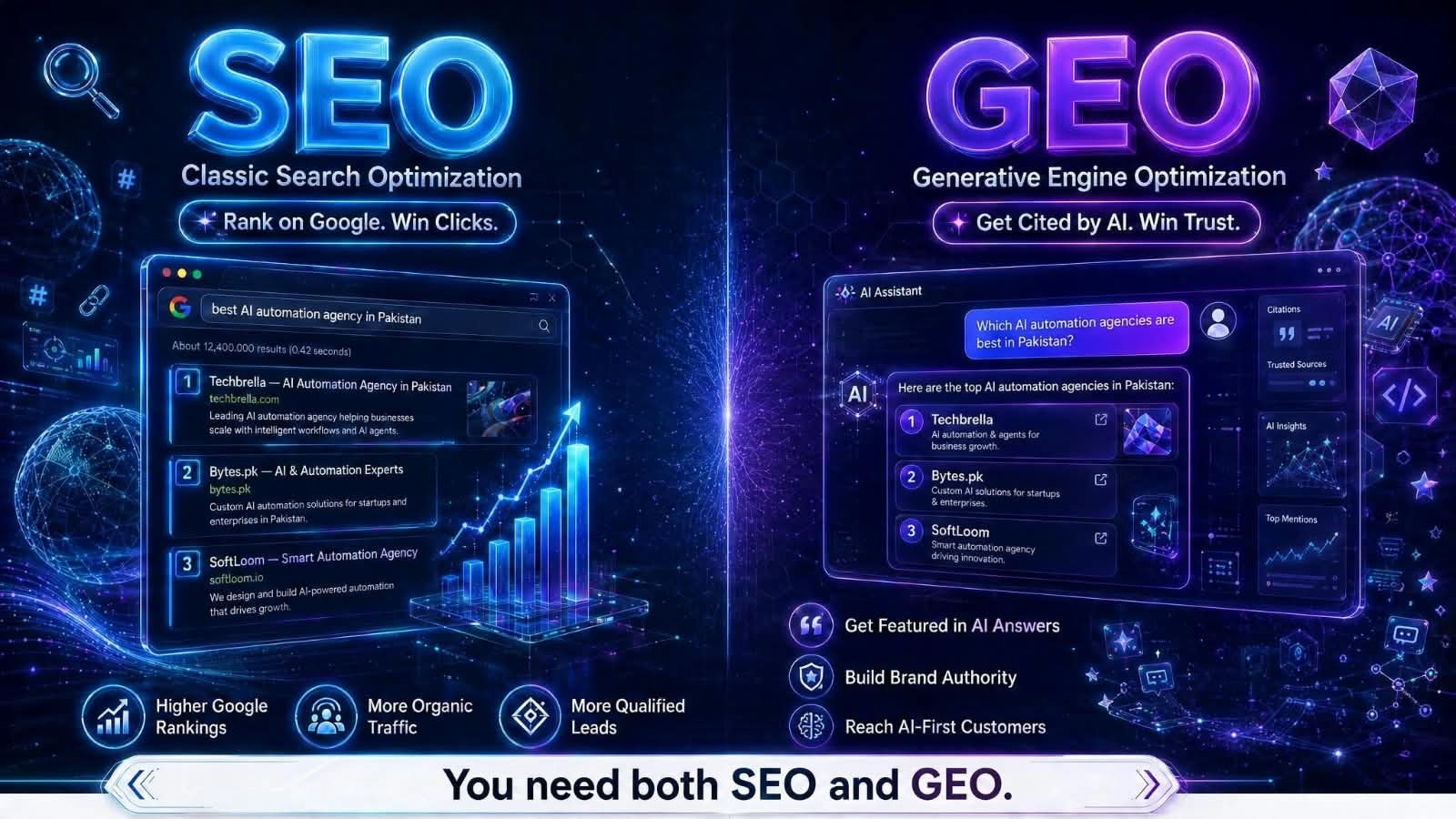
The way people search for information online is changing. A few years ago, when someone wanted to find a product, service, or answer to a question, they would usually open Google, type a few keywords, and explore the websites appearing in the search results.
Today, things are different.
People are increasingly asking questions directly to AI-powered platforms such as ChatGPT, Google Gemini, and Perplexity. Instead of browsing through multiple websites, they often receive a complete answer generated by artificial intelligence, sometimes with links to the sources used.
This change is creating a new challenge for businesses, website owners, digital marketers, and content creators.
For years, companies have invested in SEO (Search Engine Optimization) to improve their Google rankings and attract organic traffic.
Now, another concept is gaining attention: GEO (Generative Engine Optimization).
But what exactly is GEO? How is it different from SEO? Is GEO replacing traditional SEO? And most importantly, what should businesses do to remain visible in this changing digital landscape?
Let’s explore everything you need to know.
What Is SEO (Search Engine Optimization)?
SEO stands for Search Engine Optimization. It is the process of improving a website so that it appears higher in organic search results on platforms such as Google and Bing.
Think about the last time you searched for a service online.
Perhaps you searched for “best web development company in Pakistan” or “AI automation services for small businesses.”
Google displayed a list of websites related to your search. You probably clicked on one or more results to find the information you needed.
This is where SEO comes in.
The goal of SEO is to make your website more visible when potential customers search for relevant products, services, or information.
A website that ranks higher for relevant searches has a better opportunity to attract visitors, generate leads, and convert those visitors into customers.
The Three Main Components of SEO
On-Page SEO
On-page SEO focuses on optimizing the content and individual pages of your website.
It includes:
- Using relevant keywords naturally throughout your content.
- Writing compelling page titles and meta descriptions.
- Creating useful, informative articles.
- Organizing content with proper headings (H1, H2, and H3).
- Adding relevant internal links.
- Optimizing images and their alternative text.
- Making content easy to read and understand.
For example, if your company provides AI automation services, you might create a dedicated page targeting the topic “AI Automation Services for Businesses.”
That page should explain your services, their benefits, real-world applications, and how potential customers can work with you.
Off-Page SEO
Off-page SEO involves activities outside your website that help build your online reputation and authority.
Important activities include:
- Earning quality backlinks from relevant websites.
- Publishing guest articles.
- Getting mentioned by industry publications.
- Building relationships with other businesses.
- Participating in relevant industry communities.
- Developing your brand’s online reputation.
Quality matters more than quantity. A relevant mention from a trusted industry website can be more valuable than hundreds of low-quality links.
Technical SEO
Technical SEO focuses on making your website accessible and understandable to search engines.
It includes:
- Improving website loading speed.
- Making your website mobile-friendly.
- Creating XML sitemaps.
- Fixing broken links.
- Using HTTPS security.
- Improving website structure.
- Implementing appropriate structured data.
- Ensuring search engines can crawl and index important pages.
A website may contain excellent content, but technical problems can prevent search engines from accessing or understanding it properly.
In simple terms, SEO helps people discover your website through traditional search engines.
What Is GEO (Generative Engine Optimization)?
GEO stands for Generative Engine Optimization.
It is the process of improving your website, content, and online brand presence so that AI-powered search and answer systems can discover, understand, and potentially reference your business in their generated responses.
Let’s understand this with an example.
Imagine someone asks ChatGPT:
“Which companies provide AI agent development services for small businesses?”
Instead of displaying a traditional list of ten blue links, an AI assistant may generate a conversational answer. It might explain what AI agent development involves, describe relevant service providers, and include links to supporting sources.
Now imagine your company provides exactly these services.
You want AI systems to understand what your company does, recognize your expertise, and consider your content when generating answers to relevant questions.
That is the basic idea behind GEO.
Traditional SEO focuses heavily on helping your website appear in search results. GEO focuses on making your brand and information discoverable and useful within AI-generated answers.
However, there is an important distinction: GEO does not guarantee that an AI platform will mention or recommend your company. Each platform has its own systems for finding, evaluating, and presenting information.
How Does GEO Work?
AI-powered platforms may use information from different sources, including websites, articles, product pages, business information, and other online publications.
When someone asks a question, these systems may retrieve relevant information, evaluate its usefulness, and generate an answer.
Businesses can improve their chances of being represented accurately by focusing on several important areas.
Create High-Quality, Authoritative Content
Publish original content that demonstrates real knowledge of your industry.
Avoid publishing articles simply to fill your website with keywords. Focus on solving problems and answering questions that your potential customers genuinely have.
Answer Questions Clearly
AI systems need to understand the information presented on your website.
Use descriptive headings, direct answers, practical examples, and logical content structures.
For example, instead of writing a vague heading such as “Our Solutions,” use a more descriptive heading like “How AI Agents Automate Customer Support for Small Businesses.”
Build Brand Authority
Your business should have a consistent and credible presence across the internet.
Publish expert articles, earn relevant industry mentions, participate in professional discussions, and develop a strong digital reputation.
Use Structured Data
Structured data, such as Schema.org markup, helps search engines understand information about your organization, services, products, and articles.
It does not guarantee AI citations, but it can improve machine understanding of your website.
Demonstrate Real-World Experience
Publish genuine case studies, project demonstrations, original research, and practical examples.
For instance, if your company has developed an AI-powered finance application, explain the problem it solves, the features you developed, and the experience of building the product.
Real examples make your expertise easier to evaluate.
SEO vs GEO: What Are the Key Differences?
Although SEO and GEO share some common principles, their primary goals are different.
Here is a comparison:
SEO |Search Engine Optimization
Main focus | Traditional search visibility
Main objective | Improve website rankings
Platforms | Google, Bing
Content approach | Search-intent optimization
Visibility | Search engine results
Measurement | Rankings, clicks, organic traffic
GEO |Generative Engine Optimization
Main focus | AI-generated answer visibility
Main objective | Increase brand mentions and citations
Platforms | ChatGPT, Gemini, Perplexity
Content approach | Clear, useful, authoritative answers
Visibility | AI-generated responses
Measurement | Mentions, citations, AI referral traffic
There is also an important similarity.
Both strategies depend on useful information, a technically accessible website, relevant content, and a credible online presence.
This is why businesses should not treat SEO and GEO as completely separate activities.
A Practical Example: How SEO and GEO Work Together
Let’s imagine a digital agency that provides the following services:
- AI Agent Development
- Business Process Automation
- Custom AI Workflows
- AI Chatbot Development
- SaaS Application Development
The agency wants to attract business owners who need automation solutions.
How can it use SEO and GEO together?
The SEO Approach
The company creates dedicated service pages targeting relevant search queries, such as:
- AI automation agency.
- AI agent development company.
- Business process automation services.
- Custom AI software development.
It also optimizes its website structure, improves loading speed, publishes informative blog posts, and earns quality backlinks.
The objective is to appear in relevant Google search results and attract potential customers.
The GEO Approach
The same company develops educational content around the questions business owners are asking AI assistants.
For example:
- What are AI agents, and how do they work?
- How can AI agents reduce business operating costs?
- Which AI agents does a travel agency need?
- How can businesses automate customer support?
- What is the difference between AI agents and agentic AI?
The company also publishes detailed case studies, real project examples, and technical explanations.
This gives AI systems more useful information to understand the company’s expertise and services.
The result is a combined visibility strategy.
The business is working to become discoverable through both traditional search engines and AI-powered platforms.
Is GEO Replacing SEO?
This is one of the most common questions in digital marketing today.
The short answer is no.
GEO is not replacing SEO. Instead, it is expanding the way businesses need to think about online visibility.
Google remains an important source of information and potential customers. At the same time, AI-powered search experiences are changing how people discover information, compare products, and evaluate service providers.
Consider two different customer journeys.
In the first journey, someone searches Google for “website development company in Lahore,” explores several websites, and contacts a company.
In the second journey, someone asks an AI assistant, “What should I look for when choosing a website development company?” The AI generates an answer and may reference useful sources.
Both journeys can influence purchasing decisions.
Businesses that focus exclusively on traditional rankings may miss opportunities to build visibility in AI-powered discovery channels.
On the other hand, ignoring SEO while focusing entirely on GEO would also be a mistake.
The smarter approach is to build a strong SEO foundation and expand it with GEO.
Eight Practical GEO Strategies for Businesses in 2027–2028
If you want your business to become more visible in AI-powered search, here are eight strategies worth implementing.
Publish Question-Based Content
Understand the questions your potential customers ask.
Create articles that directly answer those questions.
For example, an accounting software company could publish content about automated invoicing, expense tracking, financial reporting, and accounting workflows.
Build Topical Authority
Do not publish random articles about unrelated subjects.
Choose the topics connected to your business and cover them comprehensively.
If you provide AI automation services, develop content around AI agents, business automation, workflow management, AI customer support, and industry-specific automation.
Strengthen Your Brand Identity
Make sure your company has consistent information across its website, social profiles, business listings, and relevant industry directories.
Your business name, services, website, and descriptions should accurately represent the same organization.
Publish Original Research
Original information can make your content more valuable.
Share industry observations, surveys, experiments, practical findings, and unique insights.
For example, an agency could publish a report explaining which business processes are most commonly automated by small businesses.
Create Detailed Case Studies
Case studies are powerful because they demonstrate actual experience.
Explain:
- What problem the customer faced.
- What solution you developed.
- Which technologies you used.
- How the solution works.
- What measurable results were achieved.
Avoid making unsupported performance claims.
Earn Quality Brand Mentions
Build relationships with relevant websites, publications, professional communities, and industry organizations.
Credible mentions can strengthen your brand’s online reputation.
Improve Technical Accessibility
Make sure your website is fast, mobile-friendly, crawlable, and indexable.
Use appropriate structured data and check that relevant content is accessible to search engines and AI services.
If you want a particular AI service to access your public content, review its crawler and access policies rather than assuming every AI platform uses the same crawling system.
Monitor Your AI Visibility
Regularly test relevant questions across ChatGPT, Gemini, and Perplexity.
For example:
- Which companies provide AI automation services in Pakistan?
- What are the best AI agents for small businesses?
- Which companies develop custom AI-powered SaaS applications?
Record whether your business appears, whether your website is cited, and which competitors are mentioned.
Repeat these tests over time using consistent questions. AI answers can vary between platforms and even between individual searches.
How Can You Measure SEO and GEO Performance?
You cannot measure both strategies using exactly the same metrics.
For SEO, focus on:
- Organic website traffic.
- Keyword rankings.
- Search impressions.
- Click-through rates.
- Backlink quality.
- Organic leads and conversions.
Tools such as Google Search Console, Google Analytics 4, Semrush, and Ahrefs can help you monitor these activities.
For GEO, focus on:
- How frequently your brand appears in relevant AI answers.
- Whether AI platforms cite your website.
- Which pages are referenced.
- How your brand compares with competitors.
- Referral traffic from AI platforms.
- Leads and conversions originating from AI discovery.
GEO measurement is still developing, so there is no single universal metric that fully captures AI visibility.
The most important thing is to connect visibility with actual business outcomes.
Being mentioned by an AI assistant is useful, but generating qualified leads and acquiring customers is even more important.
Why SEO and GEO Create a New Opportunity for Digital Agencies
The growth of AI-powered search is creating another opportunity for digital agencies and marketing professionals.
Businesses that previously invested only in traditional SEO may now need help understanding and improving their visibility across AI-powered platforms.
Agencies can develop additional services, including:
- Traditional SEO management.
- GEO strategy and implementation.
- AI search visibility audits.
- Website content optimization.
- Brand authority development.
- Technical SEO and structured data.
- AI visibility monitoring and reporting.
This creates opportunities to develop long-term relationships with businesses.
Instead of simply offering keyword research and website optimization, agencies can help clients build a stronger digital presence across multiple discovery channels.
The Future of Digital Visibility: SEO + GEO
The future of search will not necessarily be limited to a single platform.
People may use Google to discover websites, ChatGPT to understand complex topics, Gemini to explore information, and Perplexity to research products or services.
Businesses need to be prepared for these different customer journeys.
The strongest approach is to create a digital presence built around three important principles:
Visibility: Make your website and content easy to discover.
Authority: Demonstrate real expertise through original content, credible references, and practical experience.
Trust: Provide accurate information, transparent business details, and genuine examples of your work.
These principles support both traditional SEO and emerging GEO strategies.
Frequently Asked Questions (FAQs)
- What is the main difference between SEO and GEO?
SEO focuses on improving website visibility in traditional search engine results. GEO focuses on improving the chances that a brand’s information will be discovered, referenced, or mentioned in AI-generated answers.
- Is GEO more important than SEO in 2026?
Neither should be considered universally more important. SEO remains essential for traditional search visibility, while GEO helps businesses adapt to AI-powered discovery. A combined approach is generally more practical.
- Does GEO help websites rank higher on Google?*
GEO is not a direct Google ranking factor. However, practices such as creating useful content, improving technical accessibility, and building brand authority can also support an effective SEO strategy.
- How long does GEO take to show results?
There is no guaranteed timeline. Results depend on your existing brand authority, website content, industry competition, and the way individual AI platforms retrieve information.
- Can small businesses benefit from GEO?
Absolutely. Small businesses can create useful educational content, publish case studies, maintain consistent business information, and establish expertise in specific niches. They do not need to compete across every topic.
- Should I hire an SEO agency or a GEO agency?
Look for an agency that understands both. Your business needs a comprehensive digital visibility strategy rather than treating SEO and GEO as unrelated activities.
Conclusion
The digital world is moving beyond traditional search.
For years, businesses focused on ranking their websites on Google. Now, AI-powered platforms are creating additional ways for customers to discover information, explore solutions, and find service providers.
SEO remains important, but GEO is becoming an increasingly valuable part of digital visibility.
The goal should not be to abandon traditional SEO or chase every new AI marketing trend.
Instead, businesses should build useful websites, publish authoritative content, establish a consistent brand presence, and make their expertise easy to understand.
SEO helps people discover your website through search engines. GEO helps AI systems discover, understand, and potentially reference your brand in generated answers.
The future belongs to businesses that understand both.
Don’t just aim to rank on Google. Build a brand that people and AI-powered discovery systems can recognize and trust.
Start building your SEO + GEO strategy today.